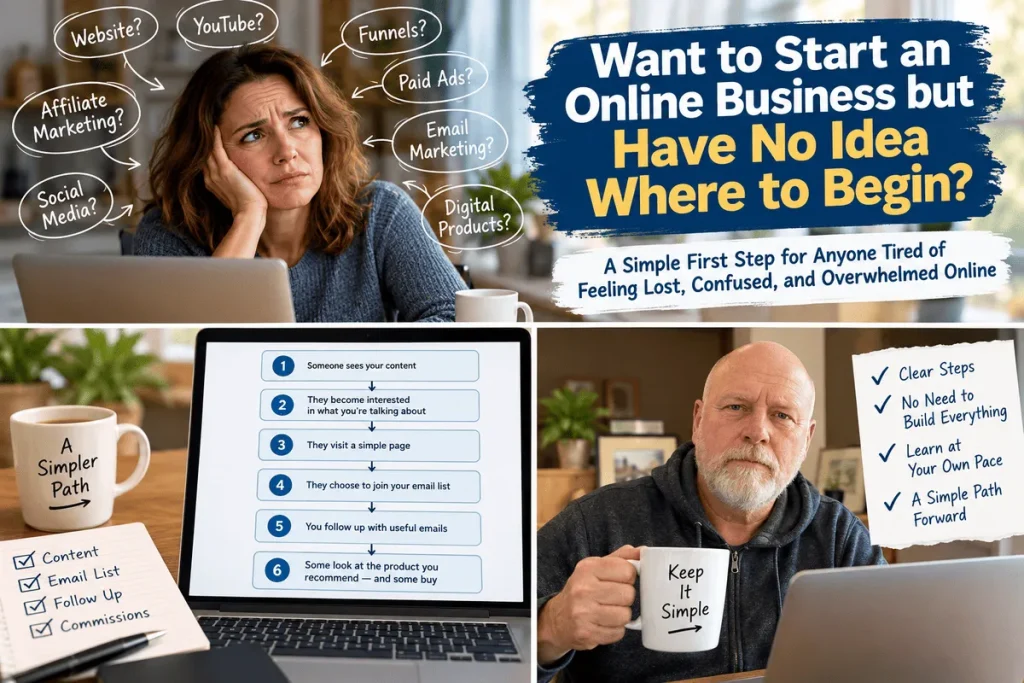

A Simple First Step for Anyone Tired of Feeling Lost, Confused, and Overwhelmed Online
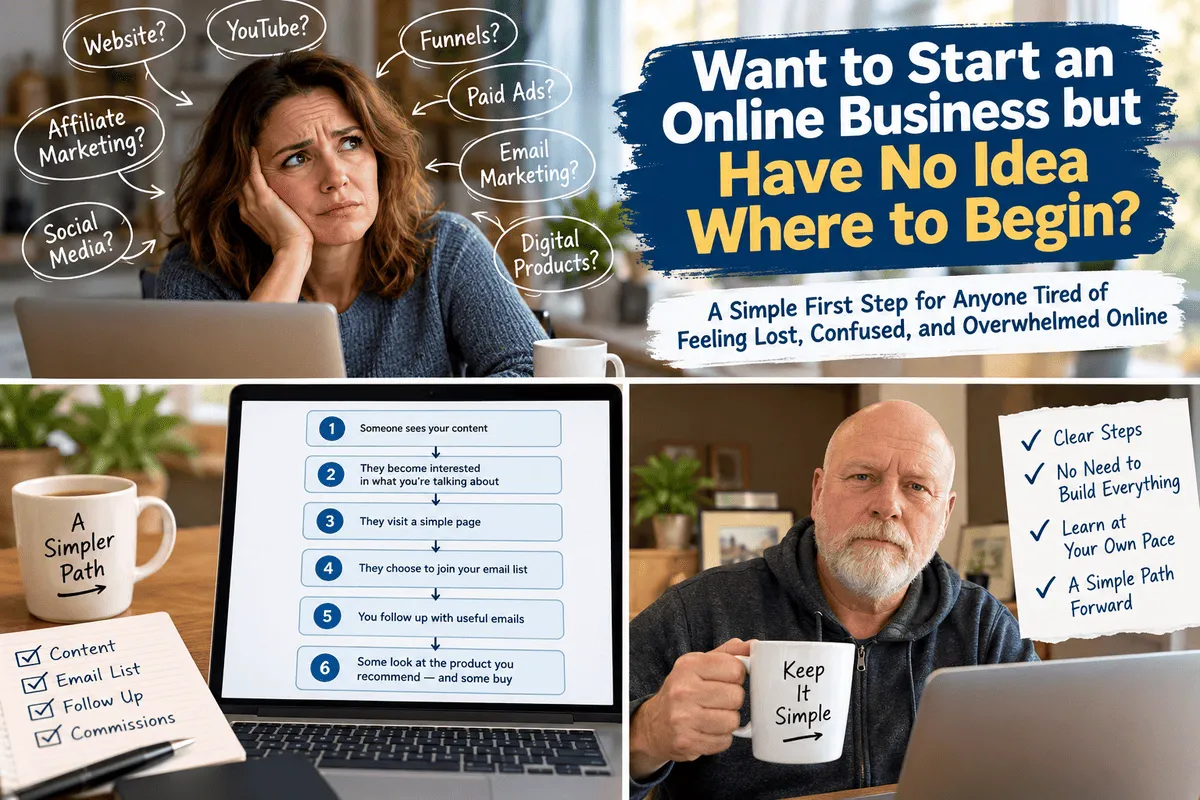
What if the real problem isn’t that you don’t know enough? But that you’ve been told to start in the wrong place?
You want to start an online business. That sounds simple enough. Then you sit down at your computer and start looking around.
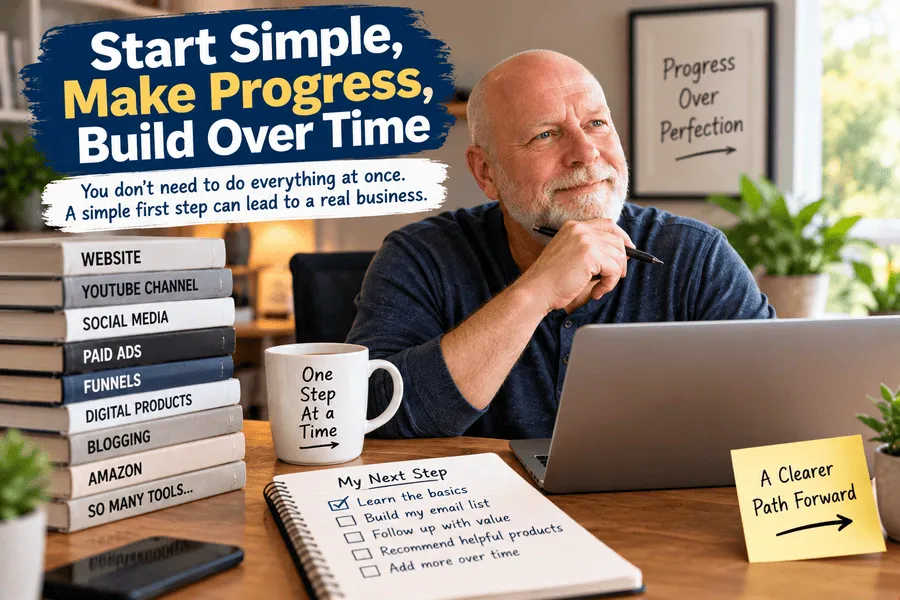
Someone tells you to start a YouTube channel. Someone else says you need a website. Another person says you should sell products on Amazon. Then you hear about affiliate marketing, email marketing, social media, paid ads, funnels, blogs, digital products, and about 47 other things you have never heard of.
An hour later, you have 15 tabs open and no idea what to do first. If that sounds familiar, you are not alone.
The problem is not that there are no ways to make money online. The problem is that there are too many ways. When you are new, you do not need more choices. You need a simple place to start.
First of All, Forget About Doing Everything
One of the biggest mistakes beginners make is trying to start an online business all at once. They think they need a website, logo, business name, Facebook page, YouTube channel, email system, product, sales page, and thousands of followers before they can begin. That is enough to make almost anyone quit.
Think about learning to drive. Nobody hands you the keys on your first day and tells you to drive across the country. You learn how to start the car. You learn how to stop. You learn how to turn. Then you get better with practice.
Building a business online works much the same way. Start with the basic parts. Get them working. Then add more when you need them. Simple usually beats complicated, especially when you are new.
What Does an Online Business Really Need?
Strip away all the fancy words, and most online businesses need a few basic things. You need something to offer. You need people who may be interested in it. You need a way to stay in touch with those people. And you need a way for them to buy when the offer is right for them. That is the basic idea.
It does not need to look like a giant company. You do not need an office. You do not need employees. You do not even need to create your own product when you are starting. This is one reason many beginners look at affiliate marketing.
Affiliate marketing means you promote another company’s product. If someone buys through your special link, you may earn a commission. You did not create the product. You do not have to ship it. In many cases, you do not handle customer support for the product. Your job is to help the right people discover something that may help them.
It is a simple idea. But there is an important part that many beginners miss.
Do Not Throw Away Every Visitor
Here is a common beginner plan. Find a product. Get an affiliate link. Post the link everywhere. I hope somebody clicks it and buys it.
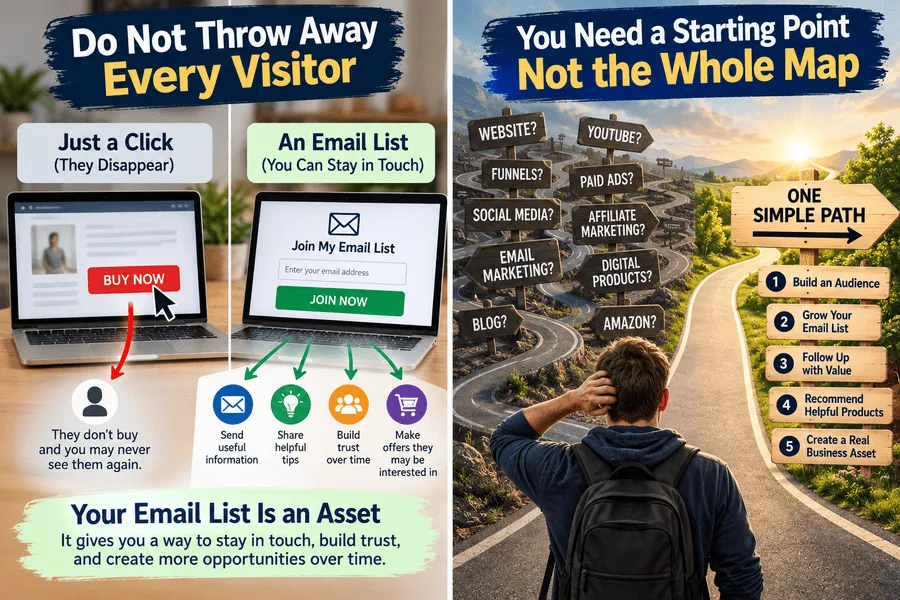
That may sound like a business, but there is a problem. What happens if the person clicks and does not buy? They disappear. You may never see them again. You spent time getting that person to click, but you have no way to keep in touch.
There is a better way to think about it. Instead of only trying to get a click, try to build an audience you can talk to again. That is where an email list comes in. An email list is simply a group of people who have chosen to give you their email address so they can hear from you. You can then send useful information, helpful tips, and offers that may interest them.
This changes the business. You are no longer hoping one click does all the work. You are building something you can keep.
Your Email List Is an Asset
The word “asset” may sound like a business-school word, but the idea is simple. An asset is something useful that you own or control. A social media post may get attention today and be forgotten tomorrow. A visitor may click your link and disappear. But when someone joins your email list, you have a way to stay in touch, as long as they want to hear from you.
That matters because most people do not buy the first time they see something. Think about your own life. Have you ever looked at a product and thought, “Maybe later”? Most of us have. Sometimes we need more information. Sometimes we want to think about it. Sometimes we are busy feeding the dog, fixing dinner, or wondering why the washing machine suddenly sounds like it has a brick inside it.
People have lives. A “not today” does not always mean “never.” That is why follow-up matters.
Follow-Up Gives People Time
Follow-up simply means staying in touch. It does not mean sending somebody 14 messages before breakfast asking why they have not bought yet. Good follow-up should be useful.
You might explain how something works. You might answer a common question. You might share a helpful tip. You might point out a problem the person has not thought about yet. Over time, people get to know what you talk about and whether they trust your advice.
Some may buy. Some will not. That is normal. No honest business can promise that every visitor will become a customer. The goal is to build a real business process instead of depending on luck.
Pick One Simple Path
This is where beginners often get into trouble again. They learn one idea on Monday. Then they watch a video on Tuesday and change everything. By Thursday, they are trying a completely different business. By Sunday, they are exhausted and looking for another course. Starting over feels like progress because you are doing something new. But it keeps taking you back to the starting line.
A better plan is to choose one basic model and give yourself time to understand it. For example, a simple affiliate business might look like this:
Someone sees your content. They become interested in what you are talking about. They visit a simple page. They choose to join your email list. You follow up with useful emails. Some people decide to look at the product you recommend. Some of those people may buy.
That is much easier to understand than trying to master ten different business models at the same time.
You Do Not Have to Build Every Piece From Scratch
Another reason beginners become overwhelmed is that they think being in business means building everything themselves. It does not. You do not build your own computer before starting an online business. You do not create your own email service. You do not need to become a computer programmer. Whenever possible, use tools, training, and systems that remove work you do not need to do. A beginner-friendly business should help you understand what comes first, what comes next, and what can wait until later.
That does not mean there is no work. There will still be things to learn. You will still need to take action. You will make mistakes. That is part of learning anything new. But there is a big difference between doing the work and trying to invent an entire business system before you understand the basics.
What Should You Do First?
If you are sitting there right now thinking, “Fine, but what should I actually do?” keep it simple. The simplest way to start an online business is to choose one model and learn how its basic parts work together. Affiliate marketing can be a beginner-friendly option because you can learn how online selling works without creating a product first. Next, learn how to collect leads instead of sending every person straight to an offer. Then learn basic email follow-up. After that, focus on one way to get people to see what you are sharing.
That could be Facebook. It could be another social platform. It could be simple written content. The exact traffic source matters less at the beginning than learning how the whole process connects. One step leads to the next. That is what you are trying to build. Not a pile of random tools. A working path.
Do Not Measure Your First Week by Money Alone
This part is important. Beginners often believe they are failing if money does not show up right away. That can cause them to quit a good plan before they have learned how it works. Your first goals can be much smaller.
Did you understand the basic business model? Did you set up the first part? Did you learn how someone joins your list? Did you create a piece of content? Did you send an email? Did you understand something today that confused you last week?
Those things may not feel exciting. But that is how skills are built. There is no honest way to promise what you will earn or how fast you will earn it. Different people have different skills, time, experience, audiences, and results. What you can control is whether you keep learning and taking useful steps.
You Need a Starting Point, Not the Whole Map
Starting an internet business can look huge when you stand at the bottom and stare at everything you think you need to learn. So stop looking at everything. Find the next useful step. Learn it. Do it. Then move to the next one.
You do not need to understand every part of online business before you begin. You need a simple model that makes sense. You need a way to reach people. You need a way to keep the leads you earn. You need follow-up. And you need enough patience to let yourself become a beginner before expecting yourself to perform like an expert.
The internet does not need to become more complicated. Your starting point needs to become simpler. If you have been stuck because you did not know where to begin, start there. One model. One clear path. One step at a time.
How I Finally Got Moving Forward
 When I first joined CB Profit Club, I felt completely lost. I wanted to make this work, but I had no idea what I was supposed to do first. There was so much to learn. Every time I watched another video or read another post, I seemed to find something else I needed to know. New tools. New ideas. New ways of doing things. Instead of feeling excited, I started to feel overwhelmed.
I remember sitting there thinking, “Where do I even start?” I was afraid of doing the wrong thing. I was afraid I would miss an important step. Some days, I spent more time trying to figure out what to do than actually doing anything. I felt stuck. And that was frustrating because I really wanted to move forward.
What changed for me was having a clear path to follow. The training inside CB Profit Club was organized step by step. I did not have to look at everything at once or try to figure it all out on my own. I could simply start with one lesson. Then I could take the next step. And then the next one.
What really caught me off guard was how organized everything was once I got inside the members area. There were clear, step-by-step directions for getting started and setting everything up. The training itself followed the same kind of progression. One section built on the one before it, so I was not trying to swallow the whole thing at once. It was broken down into bite-size pieces I could actually work through. For the first time, I was not sitting there wondering, “What am I supposed to do now?” I knew what I was working on, why I was doing it, and what came next.
That may sound simple, but for me, it was a big change. I finally stopped feeling like I was wandering around in the dark. I started to understand what I was doing and why I was doing it. Little by little, things began to make more sense. I was not trying to learn everything in one day anymore. I was learning one thing and then putting it into action. That gave me something I had been missing. Direction.
I am still learning, and I know there is more ahead of me. But now I feel like I have a path I can follow instead of trying to find my own way through all the noise. For me, that was the real breakthrough. I did not need more information. I needed a clear place to start and simple steps that could help me keep moving forward. If a simple path was enough to pull me out of that kind of overwhelm, I believe it can do the same for you. That is exactly what I want to show you next.
Ready to See This in Action?
Reading about this is one thing. Seeing it laid out is another. If you want to see what a simple version of this actually looks like in practice, I put together a plain, no-hype breakdown of the model — how the offer, the list, and the follow-up fit together. If you want to start an online business, you do not need the whole map before taking your first step.
Affiliate disclosure: My review contains affiliate links. If you join through one of those links, I may earn a commission at no additional cost to you. For more information, see the FTC’s guidance on affiliate disclosures.
Want to see the beginner-friendly program that gave me a clear place to start? Read my honest ClickBank Profit Club Review.
I invite you to leave comments, questions, or concerns and share what you would like to learn more about. I read and answer everything myself, and I make every effort to respond within two business days.
Until next time—stay steady, ignore the hype, and keep moving forward.
Bill “One Simple Plan” Marks