
No Money. No Website. Just a Simple Plan.

Affiliate marketing for beginners can feel far more complicated than it needs to be. Somebody told you to build a website. Somebody else said you need paid ads. And a third person has 17 tools open on their computer and looks like they’re launching a rocket.
No wonder affiliate marketing feels confusing.
Good news.
You can start with zero budget and no website. In this post, I’ll show you six simple steps and a first week that’s almost boring.
You need something useful to promote, a way to get in front of the right people, and a way to keep in touch with the ones who show interest.
That last part is important.
Affiliate marketing is not about tossing links all over the internet and hoping somebody buys. That’s a fine way to wear out your keyboard, but it isn’t much of a business plan.
So grab a cup of coffee and settle in.
We’re going to make this simple.
What Is Affiliate Marketing?
Affiliate marketing is pretty easy to understand.
A company has a product or service it wants to sell.
You join its affiliate program and get a special link.
You introduce people to the product.
If someone buys through your link and the sale meets the program’s rules, you can earn a commission. A commission is a small payment for helping make the sale.
You don’t have to create the product yourself.
You don’t have to pack boxes.
You don’t have to drive to the post office.
And you don’t have to turn your spare bedroom into a warehouse full of stuff your family keeps tripping over.
Your job is to connect someone who has a problem with a product that may help solve it.
Do You Need a Website?
This is one of the biggest worries new affiliates have.
“I don’t have a website. How can I start?”
Start without one.
A website can be useful later, as your business grows. But you don’t have to wait for one before you learn the basics.
Your social media account can be your starting place. It’s where you can share helpful posts and videos, and it’s where you can find out:
- What questions people ask.
- Which problems get the most attention.
- What kind of posts people like.
- What words your audience uses to describe its problems.
That’s useful information.
Later, if you decide to build a website, you won’t be staring at a blank screen wondering what to write. You’ll already have ideas based on real questions and real problems.
One more thing. You will need a way to collect email addresses. We’ll cover that in Step 5, and you still won’t need a website to do it.
First, let’s pick who you want to help.
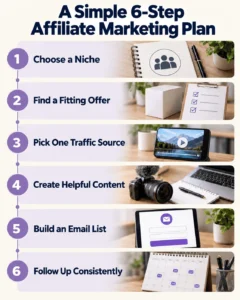
Step 1: Choose Your Niche
You’ll hear the word niche a lot in affiliate marketing.
It sounds fancy.
It isn’t.
A niche is simply a group of people who share a problem, a need, or a want.
Think about it this way.
Someone has a problem.
You share helpful posts, videos, or pictures about that problem. (Anything you share to help people is called content.)
Then you can introduce that person to a product that may help solve it.
That’s the heart of a niche.
Let’s use a new dog owner as an example.
“Dog owners” is a very broad group.
But suppose you focus on new dog owners who are trying to stop their puppies from chewing everything in sight.
Now you have a clear problem.
The new dog owner is tired of finding teeth marks on shoes, furniture, and anything else that isn’t nailed down.
If you find a useful product that helps with puppy training, you have a natural match between the person’s problem and the product.
The same idea works in other markets.
Instead of “weight loss,” you might focus on busy people who struggle to prepare healthy meals.
Instead of “gardening,” you might help beginners who can’t figure out why their tomato plants keep dying.
Instead of “making money online,” you might help complete beginners who want to start an online business but feel overwhelmed by all the choices.
A good niche does not have to be something nobody has ever thought of before.
You are looking for three simple things:
- A group of people you can reach.
- A problem they want help with.
- Products or services that may help solve that problem.
Start there.
Don’t spend three weeks trying to dream up the world’s most perfect niche.
Find a real problem that real people want help solving.
That’s plenty to get you moving.
Step 2: Find an Affiliate Offer That Fits
Now you need something to promote.
Many companies have their own affiliate programs. Even email tools like AWeber have one. So you can often find a program by searching the product’s name plus the words “affiliate program.”
There are also big marketplaces. Think of a marketplace as a mall for affiliate offers, with lots of different products in one place. Three of the biggest are ClickBank, JVZoo, and WarriorPlus. There are many more.
Whichever way you look, choose an offer that makes sense for your niche and the problem you just picked.
This is where Step 1 starts doing some heavy lifting.
If you know who you are trying to help and what their problem is, choosing an offer gets much easier.
Don’t pick a product just because you see a big commission number.
Ask yourself:
Does this product fit the problem?
Would it make sense to the person reading my content?
Can I explain in plain English why someone might want to learn more about it?
If the answer is yes, it may be worth a closer look.
Also, read the affiliate program’s rules before you start promoting. Different programs have different rules about where and how affiliate links can be used.
That may not be the most exciting part of the job.
But neither is getting your account closed because you skipped the instructions.
Step 3: Pick One Free Way to Reach People
Traffic just means people who see what you share.
If your starting budget is zero, your best place to begin is with free traffic, also called organic traffic.
Organic traffic means you are not paying a site for each visitor, click, or view.
Instead, people find you through the content you share.
That might be a Facebook post, a YouTube video, a TikTok video, an Instagram post, or a picture on Pinterest.
There is another kind of traffic called paid traffic.
With paid traffic, you pay a site to show your ad to people. This can reach people much faster than waiting for them to find you.
So there is a basic trade-off.
Paid traffic is faster, but it costs money. You also have to learn how to run ads without wasting money on the wrong people.
Organic traffic costs you time instead of ad money.
And here’s the part beginners need to hear.
Organic traffic usually takes patience.
You may spend the first few months creating content without seeing much happen.
A fair goal is to give yourself 3 to 6 months of steady effort before you decide whether your plan is working.
That isn’t a guarantee that something magical happens in month three or month six.
Some people may see results sooner. Others may take longer.
The point is that you should not post for two weeks, hear crickets, and decide affiliate marketing doesn’t work.
Organic traffic needs time to build.
People need time to find you.
The sites need time to learn who likes your content.
You need time to learn which topics get attention and which ones fall flatter than yesterday’s pancakes.
Stay the course long enough to learn from what you’re doing.
Facebook, Instagram, TikTok, YouTube, Pinterest, and other sites can all bring you free traffic.
But don’t try to use all of them at once.
Pick one.
If Facebook feels natural to you, start there.

If you enjoy making videos, YouTube or TikTok may make more sense.
If you like pictures, Pinterest or Instagram may be worth a try.
Spend some time learning how people use the one you choose.
Look at the questions they ask.
Notice the problems that come up again and again.
Those conversations can give you ideas for content.
And remember, you don’t need a huge following to begin.
You need to get your message in front of people who have the problem your niche is built around.
Step 4: Create Content That Helps
Now you have a niche, an offer, and a place to reach people.
It’s time to create content.
This is where some beginners get sideways.
They join an affiliate program, grab their link, and start scattering it everywhere like chicken feed.
Don’t do that.
Talk about the problem first.
Answer questions.
Share useful tips.
Explain mistakes.
Help people understand what may be causing their problem.
Remember the new dog owner from Step 1?
You could create a post about three reasons puppies chew things.
You could make a short video about a common puppy-training mistake.
You could answer a question from someone who can’t stop their puppy from chewing shoes.
Here’s what that first post might look like.
Why Does My Puppy Chew Everything?
Puppies chew because their gums hurt when new teeth come in. They also chew because they’re bored, and because chewing is how they learn about the world.
Here are three things that may help today:
- Give your puppy a chew toy made just for puppies.
- Trade the shoe for the toy, and say “good dog” when your puppy takes it.
- Put your shoes up high, where your puppy can’t reach them.
Have you found something that works? Tell me in the comments.
Now look at what that post did.
It named the problem.
It gave real help.
It asked a question, which gives people a reason to talk back and show you what they struggle with.
And it never mentioned a product.
That’s fine. You’re building trust first. Later, when someone asks, “Is there a training program that could help?” you’ll have a natural reason to share a product that fits.
Now you’re helping instead of simply advertising.
That difference matters.
Useful content gives people a reason to pay attention to you.
Step 5: Turn a Click Into Something You Can Keep
Eventually, someone will want to know more about the product you are talking about.
You could send that person straight to your affiliate link.
But there is a weakness in doing only that.
They click.
They look at the offer.
Maybe they buy.
Maybe they don’t.
If they leave, you may never see them again.
That’s why an email list matters so much.
When someone gives you their email address, they’re saying, “Keep in touch.” Now you have a way to reach that person again. Your list becomes something valuable that you own and can grow over time.
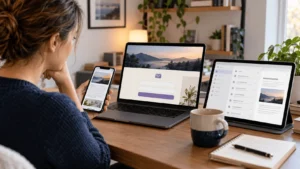
So here’s the big question. How do you start a list with no website and no money?
You need two things.
- A sign-up page. This is a simple page where a person types in their name and email address. It can be just one page. It doesn’t have to be a whole website.
- An email tool. This is the tool that keeps the email addresses safe and sends your emails for you.
Some email tools have a free starting plan. AWeber is one example. Check their site for the current limits before you sign up.
The program I use puts these pieces together for a new affiliate. It comes with free training, a ready-made sign-up page (some people call this a funnel), follow-up emails that are already written, and a calendar with 30 days of content ideas. It suggests AWeber for sending the emails, so a person can start with AWeber’s free plan.
You don’t have to use this program. You can put these pieces together yourself. But this is what I mean when I say you don’t need a website to begin.
Now for the honest part.
Free doesn’t always stay free. As your list grows, email tools may start to charge you. The program I use also offers other products, and you are not required to buy any of them. Just know that costs can show up later as your business grows, and plan for them.
The point isn’t to collect email addresses just so you can brag about having a list.
The value comes from what happens next.
Step 6: Use Follow-Up to Stay in Touch
Most people don’t buy something the first time they see it.
You probably don’t either.
Maybe you see something that interests you.
You look at it.
You think about it.
You get distracted because the dog is barking, supper is burning, or somebody wants to know where the TV remote went.
Life happens.
That’s why follow-up matters.
Email gives you a way to stay in touch with people who have already shown interest.
You can answer common questions.
You can send useful information.
You can explain more about the problem.
You can share other helpful resources.
And when it makes sense, you can point people back toward an offer that may help them.
You are not trying to hound people until they buy something.
You are staying useful and giving them a chance to learn more when they’re ready.
That is very different from hoping one affiliate link does all the work.
Keep Your First Week Simple
Your first week doesn’t need to be exciting.
In fact, boring may be better.
Use the first few days to choose your niche, name the main problem you want to focus on, and look at affiliate offers that fit.
Then choose one free way to reach people, and set up your sign-up page and email tool.
Spend the rest of the week creating a few helpful pieces of content.
That’s enough.
Don’t worry about going viral.
Don’t worry about having thousands of followers.
And don’t worry because somebody on YouTube has a microphone that looks like it belongs in a Nashville recording studio.
The internet has a funny way of making simple things look hard.
Before you know it, somebody will have you thinking you need 14 apps, three sales pages, two websites, an AI robot, and possibly a small goat before you’re allowed to start.
You don’t.
Your first goal is to learn how the pieces fit together.
Niche.
Problem.
Offer.
Content.
Traffic.
List.
Follow-up.
Once those pieces make sense, you have something you can improve.
Watch Out for the Shiny Object Trap
Here’s one last warning that can save you a lot of headaches.
As soon as you start learning affiliate marketing, you’ll find another method that looks better.
Then another.
Then another.
Before long, you’ll forget what you were trying to do in the first place.
This is especially dangerous when you’re using free traffic.
You may see somebody talking about quick results from paid ads and think your plan isn’t working.
But you’re comparing two different things. Paid traffic buys speed. Free traffic costs you time instead.
So give your plan enough time to work.
Keep creating.
Watch what people respond to.
Learn from it.
Make your next piece of content better.
Don’t jump ship every time another method floats past.
If you’re still trying to figure out how all of this fits into the bigger picture, read my blog post “Want to Start an Online Business but Have No Idea Where to Begin?” next.
That guide can help you understand the basic pieces of an online business and where affiliate marketing fits.
So, How Can You Start Affiliate Marketing With Zero Budget and No Website?
Start by finding a problem.
Choose a niche built around people who have that problem.
Find a product that may help them solve it.
Choose one free way to reach people and create useful content for the people you want to help.
Be patient. Give yourself time to learn what works instead of expecting instant results.
When people want to learn more, give them a way to stay connected with you.
Then keep helping.
That’s affiliate marketing in much simpler terms.
You don’t need to build everything before you begin.
You need to understand who you want to help, what problem they have, and what useful solution you can put in front of them.
Get that part right first.
The fancy stuff can wait.
And thankfully, so can the goat.
Ready to See What This Looks Like in Practice?
Understanding the pieces is one thing. Seeing how they work together makes everything much clearer.
I’ve put together a straightforward, no-hype review of the beginner-friendly program that gave me a clear place to start. It explains how the offer, email list, training, and follow-up system fit together. I also share what I believe the program does well and what you should know before joining.
You don’t need to understand the entire affiliate marketing map before taking your first step. You just need to know where that first step leads.
Affiliate disclosure: My review contains affiliate links. If you join through one of those links, I may earn a commission at no additional cost to you.
Read my honest CB Profit Club review.
If you have a question, concern, or topic you’d like me to cover, please leave a comment below. I read and answer the comments myself, and I make every effort to respond within two business days.
Until next time—stay steady, ignore the hype, and keep moving forward.
Bill “One Simple Plan” Marks