

THREE-PART SERIES
- Part 1: Why Sending Traffic Straight to Offers Keeps Resetting You to Zero
- Part 2: Why Building an Email List Changes the Game
- Part 3: How to Create a Simple List-First Routine Without Getting Overwhelmed
What if the most valuable thing you got from your next affiliate marketing post wasn’t a sale?
I know. That sounds a little backwards. Most of us get into affiliate marketing because we’d like to make some money. We don’t sit down one morning with a cup of coffee and think, “You know what would really make my day? Collecting email addresses.”
But here’s what I started to understand.
A sale is good. A click is good. But having a way to stay in touch with somebody who is interested in what you’re talking about?
That may be even more valuable over time.
That’s where building an email list comes in. And no, you do not need thousands of subscribers before it starts making sense.
You just need to understand what you’re really building.

What Is an Email List, Anyway?
Let’s keep this simple.
An email list is a group of people who have given you permission to email them.
That’s it.
No smoke. No mirrors. No fancy marketing language needed.
Maybe somebody signs up because you offered them a free beginner guide. Maybe they want a checklist. Maybe they read one of your blog posts and decide they want to hear more from you.
Whatever brought them in, the important part is this:
They chose to hear from you.
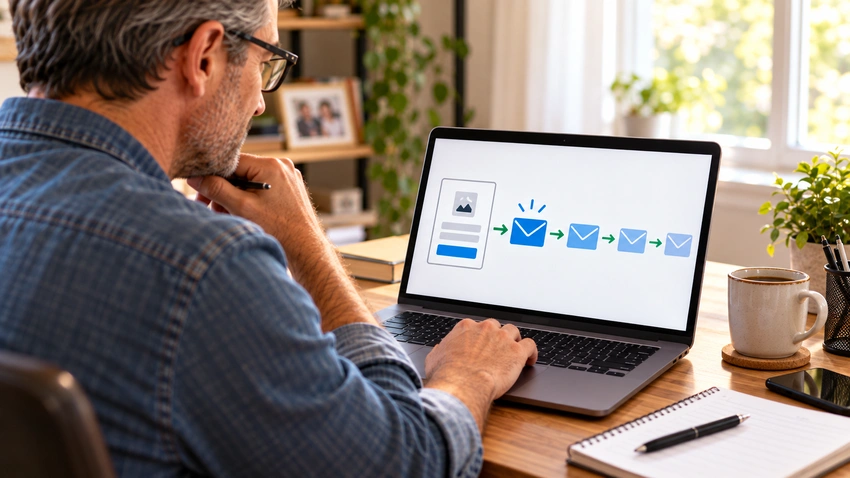
You use an email service to keep track of those people and send them messages. You’ll hear words like “email marketing platform” and “autoresponder.”
Those words sounded more complicated to me than they really are. An autoresponder is just a tool that can send emails you wrote ahead of time.
Someone signs up. They get a welcome email. You don’t have to be sitting there at the computer waiting for them.
Pretty handy.
But the software is not the important part. The important part is that the person who visited your site does not have to disappear forever.
You now have a way to stay in touch.
I use AWeber for this part of my business. If you want to see how autoresponders and email automation work. AWeber has a beginner-friendly guide that walks through the basics and shows what you can use them for.
Affiliate disclosure: If you use my AWeber link, I may earn a commission at no extra cost to you.
Why Building an Email List Matters More Than Collecting Clicks
In Part 1, we talked about what happens when you send all your traffic straight to an affiliate offer.
Somebody clicks. They look around. Maybe they buy. Maybe they don’t.
If they leave without buying, that may be the end of it.
You paid for the click, worked for the click, or spent time creating content to earn the click. And then they’re gone.
Building an email list gives you another option.
Instead of sending every visitor straight to a sales page, you can give them something useful first. Maybe it’s a beginner guide. Maybe it’s a checklist. Maybe it’s something that helps answer the exact question that brought them to your site in the first place.
If they want it, they sign up.
Now you have a way to keep helping them after that first visit. You can answer questions. You can explain things. You can share what you’re learning.
And when you find a product or service that may actually help them, you can tell them about it.
They still get to decide whether they want it.
That’s how it should be.
The email list is not there to trap anybody. It’s there to keep the conversation going.
That’s a whole lot better than crossing your fingers and hoping one click turns into a sale.
People Don’t Always Buy the First Time They Look
Think about how you buy things.
Do you buy every product the second you see it?
I sure don’t.
Sometimes I read reviews. Sometimes I compare prices. Sometimes I think about it for a few days.
Sometimes I decide I didn’t need the thing nearly as badly as I thought I did.
People online are no different.
Some people are ready to buy right now. Some need more information. Some are just kicking the tires.
There’s nothing wrong with that.
The problem comes when we treat every visitor like they have to buy on the first click.
That’s asking an awful lot from one little mouse click.
An email list gives people room to learn at their own pace. Instead of shouting, “BUY NOW!” every time they turn around, you can actually be useful.
You can answer a question today. Explain something tomorrow. Point them toward a helpful resource next week.
Sometimes that may lead to a sale. Sometimes it won’t.
But either way, you’ve had another chance to help.
And I’d rather build trust that way than try to beat somebody over the head with an offer.
The Value of Staying in Touch
Here’s a simple example.
Let’s say two people are teaching beginners how to start a small vegetable garden. Both recommend a beginner gardening kit.
The first person writes a helpful article and sends everybody straight to the gardening kit.
Some people buy. Most probably won’t. The ones who leave are gone.
The second person writes a helpful article too, but also offers a simple checklist:
“10 Things You Need Before You Plant Your First Garden.”
People who want the checklist can sign up for it.
Now that person can send them a few useful emails. How much sunlight do tomatoes need? How often should you water? What mistakes kill a garden before it gets started?
Then, every now and then, when it makes sense, they can mention the gardening kit.
Both people may make sales. But the second person has something the first person doesn’t.
A way to keep helping people who weren’t ready to buy the first time.
That’s the difference.
Not automatic commissions. Not magic. Not some secret button the gurus forgot to tell us about.
Just a relationship that doesn’t end after one visit.

Trust Is Earned One Helpful Email at a Time
This is where email marketing can go sideways.
People hear that “the money is in the list.” So they decide the goal must be to collect as many email addresses as possible.
Then the selling starts.
Offer. Offer. Offer.
Special deal. Last chance. Final warning.
Final-final warning.
Before long, the inbox starts looking like the junk mail pile sitting on the kitchen counter.
I don’t know about you, but I’ve got enough of that already.
If somebody gives me permission to email them, I believe I owe them a reason to keep opening those emails.
That means being useful.
Maybe I explain something that confused me when I first started. Maybe I point out a mistake I made. Maybe I share a tool I found useful and explain what I like about it — and what I don’t.
It doesn’t have to be complicated.
One short email that answers a real question can be worth more than a five-page sales pitch full of fancy words.
People should know what to expect from you. And if you recommend something that may pay you a commission, tell them.
Don’t get cute with it.
Trust takes time to build. And it can disappear mighty quick when somebody feels like you’ve been playing games with them.
Your List Gives You More Control — But Not Complete Control
One thing I like about building an email list is that you’re not depending completely on a social media platform.
Facebook can change the rules. Instagram can change the rules. TikTok can change the rules.
Google can change what it likes this week compared with what it liked last week.
That’s part of doing business online.
An email list gives you another way to reach people who have already said, “Yes, I’d like to hear from you.” You don’t have to hope they happen to see your next post.
You can send your message to their inbox.
Now, that does not mean you own the whole road.
Email providers have rules too. Messages can land in spam. People can unsubscribe.
You still have laws and privacy rules to follow. And if somebody doesn’t want to hear from you anymore, you need to respect that. If you want the plain-English version of the federal rules, the FTC has a helpful CAN-SPAM compliance guide for businesses that explains the basics.
But compared with depending on one social platform to show your post to the right person at the right time, an email list gives you another lane to drive in.
That’s valuable.
A Small List of Interested People Can Be Worth More Than a Big List of Strangers
It is easy to get caught up in numbers.
One hundred subscribers. One thousand. Ten thousand.
Bigger always sounds better.
But bigger doesn’t always mean better.
I’d rather have a smaller group of people who actually want to hear from me than a giant list of people who barely remember signing up.
Think about it.
One group knows what you talk about. They open some of your emails. They click when something interests them. Maybe they reply with a question.
The other group couldn’t pick your name out of a lineup.
Which group would you rather talk to?
I’ll take the interested group every time.
That doesn’t mean a small list automatically makes more money. There are too many moving parts to make that kind of promise.
But list size is not the only number that matters.
Do people open your emails? Do they click? Do they stick around? Do they ask questions?
Those things tell you whether you’re actually building a relationship.
Follow-Up Doesn’t Have to Mean Being Pushy
The words “follow-up” can make some people picture a salesman who won’t take no for an answer.
That’s not what I’m talking about.
Good follow-up means staying useful.
Say somebody downloads a beginner guide from your website. The first email says hello and gives them the guide.
The next one might explain a beginner mistake. Another might answer a common question.
Later, you may mention a tool, course, or product that fits what they’re trying to accomplish.
That’s not being pushy.
That’s a conversation.
Not every email needs to sell something. In fact, if every email you send is another pitch, don’t be surprised when people start heading for the unsubscribe button.
Your job is to give them a reason to stay.
And when they’re ready to leave, make it easy.
That’s part of treating people right.
Your Email List Is an Asset That Needs Care
You’ve probably heard the saying:
“The money is in the list.”
I think that leaves out an important part.
An email list does not magically make money because it exists. You can have a thousand email addresses and still make nothing.
The value is in the relationship.
You have to take care of that relationship.
Send useful information. Recommend things carefully. Honor unsubscribe requests. Protect people’s information.
Don’t buy lists full of strangers. Don’t add people who never asked to hear from you.
Nobody likes getting emails they never signed up for.
The simple rule I try to follow is this:
Treat subscribers the way I would want a business to treat me.
That’ll keep you out of a fair amount of trouble.
You Don’t Need to Build Everything at Once
If all of this is starting to sound like another full-time job, I understand.
Most beginners already have enough going on.
You’ve got work. Family. Bills. Life.
And in my case, trucking has a funny way of eating whatever free time I thought I had.
The last thing you need is somebody telling you that you have to build a complicated website, buy five pieces of software, learn twelve new tools, and have it all running before supper.
You don’t.
At the beginning, you need three basic things.
A way for people to subscribe. An email service to manage those subscribers. And something useful to say after they join.
That’s the basic machine.
You can learn the fancy stuff later.
You do not need every shiny new tool that rolls down the highway.
A simple system you understand is a whole lot better than a complicated system you never finish.
What You’re Really Building
The more I learn about affiliate marketing, the less I want to think only about the next click.
I want to think about what all this work is building.
A social post may bring someone to my website. A blog article may help answer a question. A free guide may help them take the next step.
And an email list gives us a way to stay connected after that first visit.
It won’t do the work for me. It won’t turn every subscriber into a buyer.
And it sure won’t make everything happen overnight.
But it gives me something I can keep building.
That’s why I believe building an email list makes sense as one of the first goals for affiliate marketing beginners.
You’re not just chasing clicks.
You’re building an audience. You’re building trust. And you’re giving interested people a reason to come back.
That means some of the work you do today may still be working for you tomorrow.
To me, that makes a whole lot more sense than starting from zero every morning.
Coming Up in Part 3
Understanding why an email list matters is one thing.
Actually putting one together can feel like a whole different animal.
Forms. Pages. Email software. Welcome messages. Follow-up emails.
Pretty soon, a beginner can be sitting there wondering what in the world they’re supposed to work on first.
That’s what we’re going to straighten out in Part 3.
In How to Create a Simple List-First Routine Without Getting Overwhelmed, we’ll walk through the basic pieces and put them in an order that makes sense.
No fancy setup. No trying to build everything in one weekend.
Just a practical way to start putting the pieces together one step at a time.
Read Part 3: How to Create a Simple List-First Routine Without Getting Overwhelmed.
If you have a question, concern, or topic you’d like me to cover, please leave a comment below. I read and answer the comments myself, and I make every effort to respond within two business days.Until next time—stay steady, ignore the hype, and keep moving forward one step at a time.
Bill Marks
Bill Marks Online