

THREE-PART SERIES
- Part 1: Why Sending Traffic Straight to Offers Keeps Resetting You to Zero
- Part 2: Why Building an Email List Changes the Game
- Part 3: How to Create a Simple List-First Routine Without Getting Overwhelmed
You don’t need a fancy website, a pile of software, or eight hours a day to start building an email list.
What can stop you before you ever collect your first subscriber is trying to build the whole business at once.
When beginners start looking into email marketing, they run into funnels, landing pages, autoresponders, lead magnets, traffic strategies, signup forms, welcome emails, follow-up sequences, analytics, and enough other stuff to make your head hurt. When I first started trying to figure out how to build an email list, I thought the hard part would be the technology.
Good grief.
That’s enough to make somebody close the laptop and decide mowing the yard suddenly sounds pretty good.
I understand that feeling because I’ve been there. When everything looks important, it’s mighty hard to figure out what you’re supposed to work on first.
The answer isn’t to work faster. It’s to put the pieces in order.
You need a few basics, a little time each week, and a routine that fits the life you’re already living.
Let’s make this a whole lot simpler.

Start With One Person and One Problem
Before you buy software, build a page, or worry about traffic, decide who you’re trying to help.
Not everybody on the internet. That road will wear you out in a hurry.
Pick one type of person with a problem you understand. Maybe that’s beginners learning affiliate marketing. Maybe it’s gardeners, homeowners, people trying to save money, or some other group you know something about.
Then ask yourself what they’re trying to figure out.
For example, somebody new to affiliate marketing might be confused about choosing a product to promote. They don’t need you to teach them everything about online business. They need help with the problem sitting in front of them.
That’s something you can create useful content around.
You don’t have to know everything. I certainly don’t. But you should be honest about what you know, what you’re still learning, and what you can explain in a way that helps somebody else.
That’s enough to get started.
Step 1: Create One Helpful Free Resource
You’ll hear marketers call this a lead magnet.
The first time I heard that term, it sounded like something you’d find hanging on the wall at a hardware store.
It’s not nearly that complicated.
A lead magnet is simply something useful you give to people who want more information. If they want it, they can choose to join your email list.
The key word is useful.
You do not need to write a fifty-page ebook. A one-page checklist that solves one small problem may be more valuable to a beginner than a giant guide they’ll download, save somewhere, and never open again.
Let’s say you’re helping new affiliate marketers. You might create:
Five Things to Check Before Promoting an Affiliate Product
The checklist could remind them to look at what the product does, who it’s meant for, the seller’s reputation, the affiliate terms, and whether they would feel comfortable recommending it to somebody they know.
That’s useful without being complicated.
You can create something like that with a basic document editor and save it as a PDF. It doesn’t need twenty graphics, fancy animation, or enough design work to qualify for an art show.
It just needs to help.
And don’t promise some giant result your free resource can’t deliver. Helping somebody take one useful step is plenty.
Step 2: Give People a Simple Place to Subscribe
Once you have something worth giving away, people need a way to ask for it.
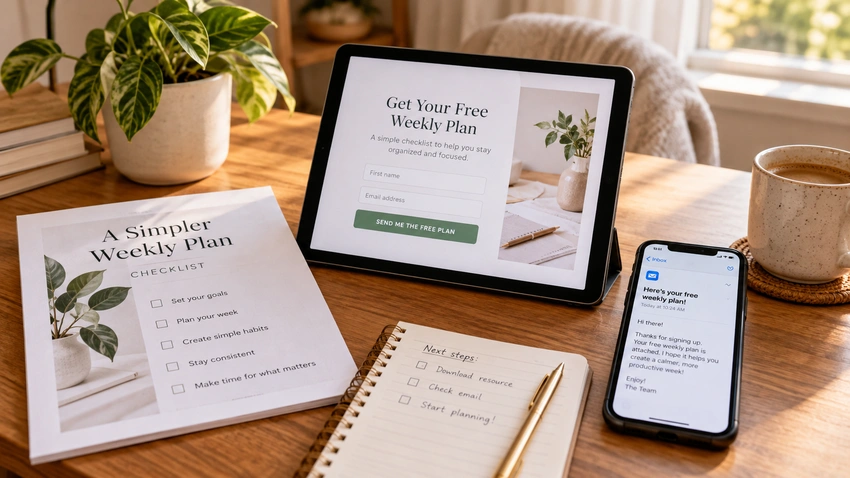
That’s where an opt-in page comes in.
An opt-in page is simply a page where somebody can enter an email address and request your free resource. It doesn’t need twelve sections, spinning graphics, a countdown timer, or fireworks behind the signup button.
Tell people what they’re getting, who it’s for, and what kind of emails you’ll send afterward.
Something as simple as this can work:
New to affiliate marketing?
Get a free checklist to help you look at affiliate products before deciding what to promote.
Sign up to receive the checklist and occasional beginner tips by email.
That’s clear. Nobody has to hunt around trying to figure out what they’re signing up for.
You’ll also need an email service to collect those addresses and send your messages. I use AWeber for that part of my own business. It handles my subscriber list, signup forms, welcome messages, and automated follow-up.
I’m not saying you have to use what I use. Compare the options and choose something that makes sense for your budget and is simple enough for you to operate without needing a degree in computer science.
Your signup form should also tell people what they’re agreeing to receive and connect them to your privacy information.
It doesn’t have to be beautiful on Day 1.
It does have to work.
Step 3: Write Your Welcome Email Before You Find Subscribers
Before you start sending people to your signup page, write the first email they’re going to receive.
That’s your welcome email.
It doesn’t need to sound like the State of the Union. Thank them for signing up, give them what you promised, and tell them what kind of emails they’ll receive from you.
Something simple works:
“Thanks for signing up. Here’s the checklist I promised.
I hope it helps you make a better-informed choice about the products you promote.
I’ll also send occasional tips about getting started with affiliate marketing. If these emails ever stop being useful to you, there’s an unsubscribe link below.”
Friendly, clear, and no funny business.
An email service like AWeber can send that message automatically as soon as somebody joins your list. That’s what people mean when they talk about an autoresponder.
The name sounds fancy. The job isn’t.
Someone signs up, and the email you’ve already written goes out automatically.
Before you invite anybody else to sign up, test the whole process yourself. Use an email address you control, complete the signup form, make sure the welcome email arrives, click the download link, and open your free resource.
Finding your own broken link is irritating.
Having your first subscriber find it for you is worse.
Step 4: Choose One Main Way to Bring People In
Once the signup process works, you need visitors.
This is where beginners can make life ten times harder than it needs to be. They decide they need Facebook, Instagram, TikTok, YouTube, Pinterest, a blog, paid ads, SEO, and three platforms they hadn’t even heard of last Tuesday.
There is no prize for being exhausted on every social platform at the same time.
Start with a traffic method you can realistically keep using.
If you like writing, blogging or social posts may suit you. If you enjoy video, use video. Pick something that fits your time instead of something that merely sounds impressive.
In my own business, I use several social platforms now, but I don’t sit there manually posting every piece of content one platform at a time. I use Metricool to help me organize and schedule much of it.
That saves time, but Metricool doesn’t create the reason for somebody to care about my content. I still have to give them something useful.
That’s an important distinction.
A tool can make the job easier. It can’t make boring content interesting or make people trust you.
Whatever platform you use, answer real questions.
Explain something that confused you when you started. Talk about a mistake. Show people one practical next step.
When it naturally fits, invite interested readers to get your free resource.
Don’t plaster the signup link everywhere like you’re putting up yard-sale signs.
Give them a reason to want it.

Step 5: Write a Few Emails Worth Opening
In Part 2, we talked about why follow-up matters. Now we need something worth following up with.
You don’t need thirty emails before you begin. Start with a welcome message and three useful follow-up emails.
For example:
Email 1: A Common Beginner Mistake
Explain why choosing an affiliate product only because it pays a big commission can get you headed in the wrong direction.
Email 2: A Simple Way to Learn About Your Audience
Show people how to notice the questions beginners keep asking in groups, comments, forums, and conversations.
Email 3: What to Look for Before Recommending Something
Talk about whether a product actually fits the people you’re trying to help and whether you’d feel comfortable putting your name behind it.
Those emails don’t need to be novels. A few useful paragraphs answering one real question are enough.
Later, when you find a product, service, or training resource that honestly fits, you can recommend it and explain why.
If you might earn a commission, tell them.
That’s not something to hide in the weeds.
The goal is simple: become somebody whose emails people have a reason to open.
Step 6: Build the Routine Around Your Real Life
This may be the most important part of the whole plan.
If the routine doesn’t fit your real life, eventually it becomes another unfinished project.
Some people make online-business schedules that apparently assume you’ve got no job, no family, no bills, no errands, and nothing better to do all day than stare at analytics.
Real life doesn’t work like that.
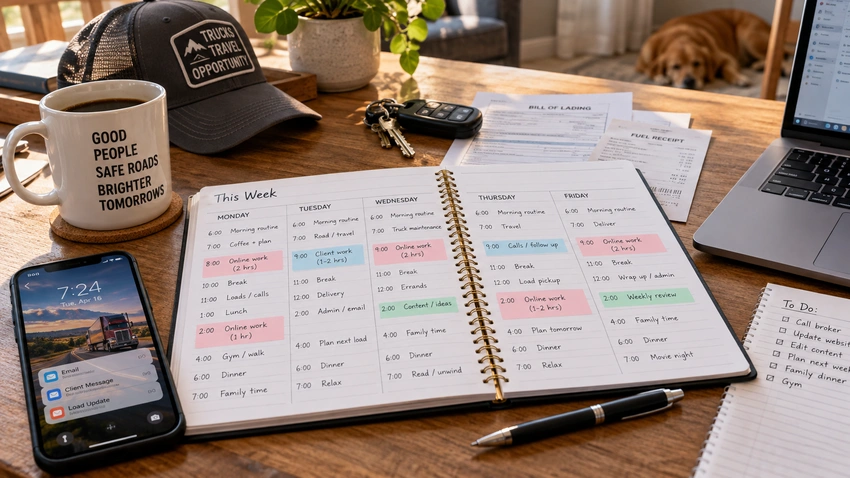
Some days you may have an hour. Some days you may have twenty minutes.
And some days, if you’re like me, trucking will look at whatever plans you made and laugh.
You work with the time you’ve got.
Here’s one example of a simple weekly routine after the basic setup is working.
A Simple Weekly List-First Routine
Monday: Find one useful topic.
Spend twenty minutes looking for one question your audience needs answered. Write it down and stop there.
Tuesday: Create one useful piece of content.
Take that question and answer it in plain English. Don’t try to solve every problem the reader has ever had.
Wednesday: Publish and share it.
Put the content where your audience can see it. If the free resource naturally fits, mention it.
Thursday: Work on one email.
Write one useful message or improve one that’s already in your follow-up sequence.
Friday: Look at what happened.
Did people see the content? Did anyone visit your page? Did somebody subscribe? Did your emails go out correctly?
Make a few notes. You don’t need to hold a corporate board meeting with yourself.
Weekend: Catch up or take the weekend.
If you’ve got extra time and want to use it, fine. If you don’t, leave it alone.
The internet will survive until Monday.
The exact days don’t matter. The point is to give each piece of the business a job instead of trying to do everything every day.
Step 7: Look at the Numbers Without Letting Them Drive You Crazy
Once everything is running, you’ll want to know whether it’s working.
That’s reasonable.
What’s less useful is checking the numbers every ten minutes like another subscriber might sneak in while you’re making coffee.
I’ve done enough of that to know the dashboard doesn’t move any faster just because I stare at it.
Look for clues instead.
If people see your content but hardly anybody visits your signup page, your invitation may need work.
If they reach the signup page but don’t subscribe, perhaps the free resource isn’t answering a problem they care enough about.
If subscribers stop opening your emails, maybe the topics or frequency need adjusting.
Notice the word maybe.
Numbers can point you toward the right questions. They don’t always tell you the answer.
That’s one reason I like having Metricool in my own setup. It gives me a place to look at what’s happening with my social content without bouncing from platform to platform trying to piece everything together.
Then I can make a decision instead of guessing.
Give yourself enough time to collect useful information and change one thing at a time.
Otherwise, you can stay mighty busy fixing things that weren’t broken.
How to Build an Email List Without Making It Complicated
Starting an online business does require some tools, but that doesn’t mean you need every tool somebody tries to sell you.
Affiliate disclosure: If you join or purchase through my affiliate link, I may earn a commission at no additional cost to you.
I use AWeber for email, Metricool to help manage my social posting, and D9 Hosting for my website and hosting.
Those are tools that currently have jobs in my business.
That’s the standard I’d use before buying anything:
What job will this tool do for me?
If I can’t answer that, I probably don’t need it yet.
The same applies to your website. You need dependable hosting and somewhere to put your pages and content, but you don’t need a server room under the house. I use D9 Hosting because it handles that part of my setup and lets me concentrate on the site itself.
That doesn’t mean everybody needs the same combination of tools I use.
It means every tool should earn its place.
A piece of software can save time, organize information, send an email, host a page, or schedule a post.
What it cannot do is make somebody trust you.
It can’t turn a bad offer into a good one.
And it sure can’t make somebody buy something they don’t need.
Learn While You’re Building
There is a sneaky little trap in online business that looks an awful lot like productivity.
You read another article.
Watch another video.
Buy another course.
Open fifteen tabs.
Compare three tools.
Take a pile of notes.
Then look up and realize you haven’t actually built anything.
Learning matters. I’m certainly not knocking education.
But eventually you’ve got to put some of it to work.
You don’t need to understand every part of email marketing, websites, content, SEO, and traffic before taking your first step.
Learn enough to make a sensible decision, build one piece, test it, and improve it.
You’re going to make mistakes.
So am I.
That’s not proof the system is failing. Sometimes it’s just proof you’re actually doing something instead of reading about doing it.
The goal isn’t perfection.
It’s building something useful that you understand well enough to keep improving.
Start Small and Give Yourself Something to Build On
Across this three-part series, we’ve really been talking about one problem.
Starting over.
In Part 1, we looked at what happens when every visitor gets sent straight to an affiliate offer and then disappears.
In Part 2, we looked at how an email list gives interested people a way to stay connected after that first visit.
Part 3 is about putting those ideas into a routine you can actually manage.
You don’t need twenty moving parts.
You need an audience you understand, something useful to offer them, a way to stay connected, and a reasonable way to bring new people into the process.
If you’re wondering where to begin, grab a sheet of paper.
Write down one type of person you want to help, one problem they’re trying to solve, and one small resource that could help them take the next step.
That’s enough homework for today.
No three-day font search required.
Want a Little Help Putting the Pieces Together?
You can build this kind of setup yourself, piece by piece.
But I also understand why a beginner might look at the whole process and think, “Okay Bill, I get the idea. I’d still like somebody to show me what goes where.”
That’s one reason I joined The ClickBank Profit Club.
It’s a free beginner membership built around the same basic list-first idea we’ve been talking about: rather than depending only on one-time affiliate clicks, you work on building an email list, following up with interested people, and creating opportunities for commissions along the way.
The training comes from John Thornhill, who has more than 20 years of online business experience and has earned nine ClickBank Platinum awards.
The part that appealed to me was the structure.
When I was starting out, I didn’t need somebody throwing fifty more ideas at me.
I needed to know what came first.
Then what came next.
That’s what I found useful about having a model to follow.
Now, joining a program doesn’t build the business for you. You’ll still have to learn, do the work, make mistakes, fix things, and give yourself time.
No magic beans hiding behind the signup button.
But if you’d rather have a clearer path to follow than try to figure out every piece from scratch, I think it’s worth taking a look.
Take a Look at The ClickBank Profit Club
Whether you take a look at it or build everything on your own, the starting point doesn’t change:
One audience. One problem. One useful first step.
That’s enough to get moving.
If you have a question, concern, or topic you’d like me to cover, please leave a comment below. I read and answer the comments myself, and I make every effort to respond within two business days.
Until next time—stay steady, ignore the hype, and keep moving forward one step at a time.
Bill Marks
Bill Marks Online